

“How do you engage the quiet ones?”
That’s a question I get asked a lot.
And maybe you know this situation…
You’re leading a live online session.
You ask for volunteers.
The same hands go up.
You ask a question.
The same people jump in.
Meanwhile, you know there are brilliant humans sitting quietly on the other side of the screen. But you just can’t seem to get them to chime in.
You try to make Zoom eye contact.
“Anyone else?”
No response.
You pause but still nothing.
And suddenly the silence feels like it’s stretching into eternity. 😳
So you do what many of us do –> You call on the chatty people.
Again.
Not because you want to ignore the quieter folks.
But because live facilitation happens fast. And awkward silence online can feel weirdly louder than it does in person.
Here’s the problem:
When we only design for the people who are fastest to speak, we miss out on a huge chunk of the wisdom in the room – about 30% if you want to put a number on it:)
And that’s not an introvert problem.
That’s a design problem.
It’s easy to assume assume that quiet = checked out.
Sometimes, sure, people are distracted.
But often, quieter participants are engaged.
They’re listening.
Processing.
Noticing patterns.
Forming thoughtful ideas.

They just don’t want to fight for airtime.
Or they need a little more time before they share.
Or they prefer to contribute in writing before speaking out loud.
And online, this gets even trickier.
We lose many of the cues we rely on in person. We can’t always see someone leaning forward, nodding, or looking thoughtful. Cameras may be off. Chat may move quickly.
Without realizing it, we can give most of the floor space to the fastest, loudest, most comfortable voices.
Not because they have the best ideas.
But because the session design gives them the clearest path in.
Introvert-friendly design helps everyone
Designing for introverts doesn’t mean making your session quiet, slow, or low energy.
It means giving people more than one way to participate.
And honestly?
That helps everyone.
✔️Introverts get more space to think.
✔️Extroverts get better contributions to respond to.
✔️The group gets more diverse perspectives.
✔️You get a more accurate read of what’s actually going on.
This matters because your job isn’t to reward the fastest hand raise.
Your job is to create the conditions for more voices to enter the room.
So how do you do that?
Here are five small shifts that have helped me bring more voices into my live online sessions:
1️⃣ Give people time to think before they share
Instead of asking a question and immediately waiting for answers, try this:
“Take 30 seconds to jot down your thoughts before we hear from a few people.”
This gives reflective thinkers time to gather their ideas and makes the silence feel intentional instead of awkward.
2️⃣ Use chat before voice
Before you invite people to come off mute, ask everyone to drop a quick response in the chat.
Try a prompt like, “What’s one word that describes your reaction?” or “What’s one question this brings up?”
This gives quieter participants a low-pressure way in and gives you a richer read of what’s happening across the whole room.
3️⃣ Invite, don’t ambush
Instead of putting someone on the spot, open the door for quieter voices to step in.
Try saying, “I’d love to hear from someone who hasn’t spoken yet — you can come off mute or drop your thought in the chat.”
This gives people choice and warning, which makes participation feel safer and less like a surprise quiz.
4️⃣ Use low-stakes tools
Use tools like polls, reactions, annotation, word clouds, or anonymous Q&A to help people contribute without feeling exposed.
Try asking a quick poll question before opening discussion, like, “Which part feels the most challenging right now?”
This surfaces what people are thinking across the whole group before you ask anyone to speak out loud.
5️⃣ Name the participation options
At the start of your session, tell people exactly how they can take part.
Try saying, “You’ll have a few ways to participate today: chat, reactions, reflection, small groups, and voice.”
This removes the guesswork and helps people see that engagement doesn’t always have to mean speaking out loud.
So instead of asking:
“How do I get the quiet people to talk?”
Try asking:
“How do I make it easier for everyone to contribute?”
👆That shift changes everything.
Over to you 🎤
👉 So here’s a challenge for you:
What’s one shift to your design that would make it even more introvert-friendly?
Hit reply and let me know—I’d love to hear what you try.
You are invited! 📆
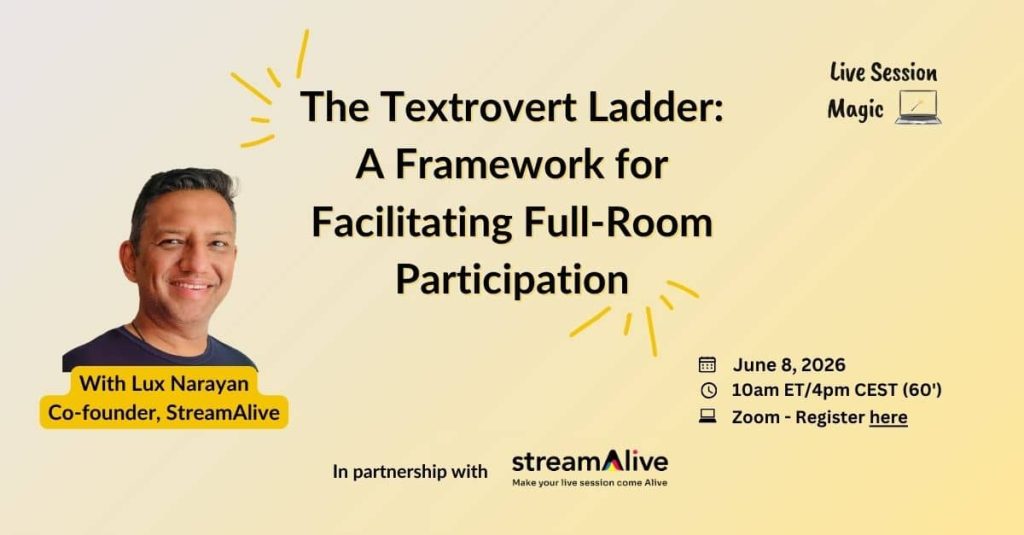
I’m hosting a free interactive live session on Monday, June 9th with Lux Narayan, Co-founder of StreamAlive, one of my favourite engagement platform for live sessions.
It’s called:
The Textrovert Ladder: A Framework for Facilitating Full-Room Participation
Lux will share a step-by-step framework that move people from silent observation to meaningful contribution — without forcing awkward “everyone must speak now” moments.
If you’re looking for practical ways to engage quieter participants – while having a lot fun – this session is for you.
Sign up for the free event here 👉 link.
💌 Thanks for reading The Quest
I always love hearing your feedback and suggestions. Just hit reply to share your thoughts and ideas.
If you were forwarded this email, you can subscribe to The Quest 👉here.
If you enjoy The Quest, I’d appreciate it if you shared it with anyone you think might like it.
Creatively yours,

Whenever you are ready there are 2 more ways I can help you:
👉Custom coaching & team training. Book a free 15-minute zero-commitment call with me to see how I can support you and your team.
👉 Live Session Design Video Course. Live Session Magic gives you a proven system for designing consistently high-quality online sessions. Join the interest list here and be the first to get access.
👉5-week Live Online Course. The Breakthrough Facilitation course gives you tools, personalized feedback, and a proven framework for designing and leading high-engagement live sessions. Join the interest list and be the first to get the next cohort dates and discounts.
