

What if the best way to change a conversation is to change where it happens?
Last Friday morning, I found myself having a “meeting” on a paddleboard in the middle of Lake Ontario. 🌊
I was with Chad Littlefield, whose work on connection and group dynamics I’ve followed for years.
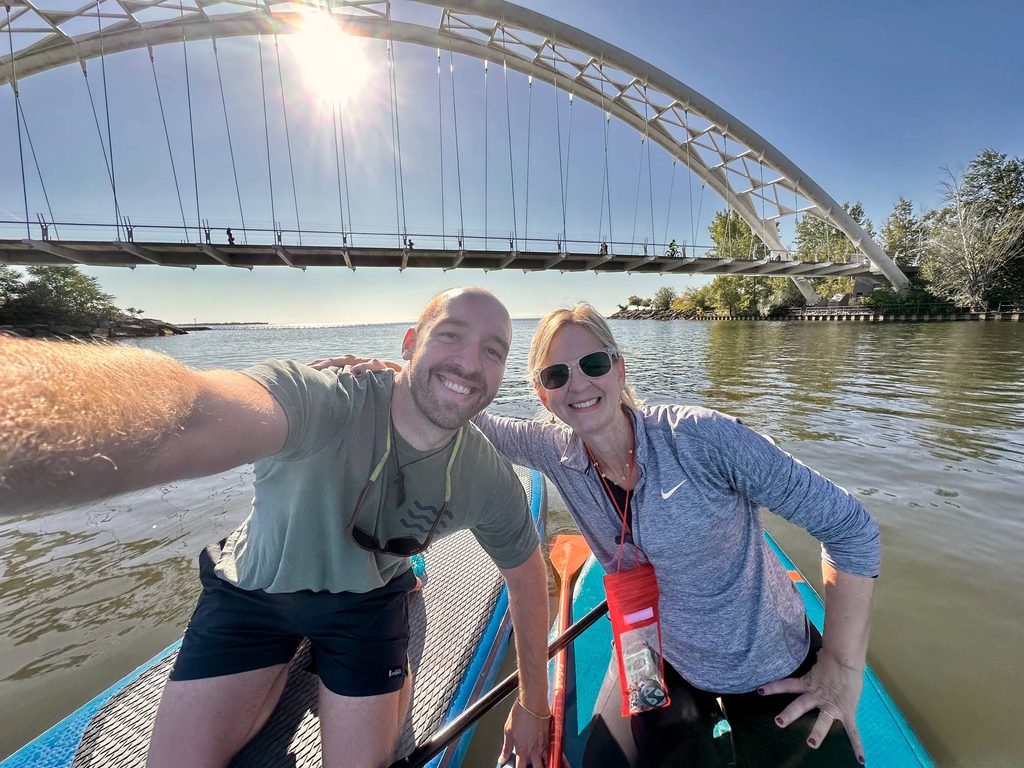
We could easily have met for coffee, sat across from each other at a table, and had a perfectly good conversation.
Instead, we paddled past bird sanctuaries, explored a part of Toronto that was new to both of us, and talked while moving through the water.
And somewhere between trying not to fall in and spotting salmon swimming upstream, I kept thinking:
✨The setting shapes the connection.✨
Re-thinking the “WHERE”
As facilitators, trainers, coaches, and group leaders, we put a lot of thought into WHAT we want people to experience.
We plan the questions. We structure the agenda. We think about timing, breakouts, activities, and outcomes.
But we don’t always think about WHERE the conversation happens or how that environment affects the way people show up.
It’s easy to see how this plays out in person.
A conversation around a boardroom table feels different from a conversation on a walk. Sitting face-to-face can feel more formal or intense. Moving side-by-side can make it easier to think aloud, wander a little, and say things you might not say in a more structured setting.
But the same thing happens online.
It’s even easier to assume the setting is fixed: sitting at your desk, face the screen, stay there for the next hour. The problem is that physical sameness comes at a cost.
Energy dips.
Attention wanders.
Fresh thinking gets harder.
And even an important conversation can start to feel like just another Zoom call.
The good news? Your physical setting online isn’t as fixed as it seems.
You’ve got more options than you think.
I get that you may not be able to take your next Zoom session onto Lake Ontario.
But you can still change the setting in small ways.
And those small shifts can spark fresh thinking, shake people out of screen fatigue, reduce distractions, and make the whole experience more memorable. That’s what makes the learning more likely to stick.
How to Switch Up the Setting in Virtual Calls
Here are five surprisingly simple ways that I’ve led or experienced that intentionally shift the physical setting in a virtual session. I hope these will spark some new ideas for your virtual sessions.
1️⃣ Invite people outside
If the conversation is reflective, exploratory, or personal, invite participants to join from a balcony, garden, porch, or nearby park if that works for them.
Even ten minutes outside can make the interaction feel less like “another Zoom call” and more like a different kind of conversation.
2️⃣ Try a walk-and-talk
For a paired reflection or coaching conversation, invite people to grab their headphones, turn off their cameras, and walk while they talk.
You could send pairs into breakout rooms and simply say:
“Take the next ten minutes away from your screen. Walk if you can, and use the time to explore this question together.”
That shift can feel surprisingly freeing.
3️⃣ Get people standing
Sometimes you don’t need a whole new location. You just need a different physical state.
Invite people to stand for a brainstorm, a quick reflection, or a partner conversation.
Standing can create a little burst of energy and signal that the next part of the session is different.
4️⃣ Change seats
Ask people to take their laptop or mobile phone and move somewhere else for a few minutes.
A different chair. A spot by the window. The floor. Another room.
It sounds almost too simple to matter, but the physical move creates a transition. It tells your brain: we’re doing something different now.
5️⃣ Step away from the screen
Not every online conversation needs slides, chat, Miro, or even video.
Sometimes one of the best things you can say is:
“Grab your headphones. Turn your camera off. You don’t need to look at the screen for this next part.”
That permission alone can make a conversation feel more spacious.
Design the setting, not just the agenda
Here’s one thing I took from my paddle with Chad: the next time you’re designing a live online session, add one more question to your planning:
WHERE could this conversation happen?
Not every activity needs a different setting. But for the conversations that really matter — reflection, connection, creativity, coaching — it’s worth asking whether a small physical shift could help people show up differently.
Over to you 🎤
How could you apply this to your sessions? Hit reply and let me know!
By the way… if you are serious about connecting people, I’d highly recommend checking out Chad’s Connector Summit December 9-11 – easily one of the best live online events I attended last year. (No affiliate link or commission here – I just really believe in Chad’s work).
💌 Thanks for reading The Quest
I always love hearing your feedback and suggestions. Just hit reply to share your thoughts and ideas.
If you were forwarded this email, you can subscribe to The Quest 👉here.
If you enjoy The Quest, I’d appreciate it if you shared it with anyone you think might like it.
Creatively yours,

Whenever you are ready there are 2 more ways I can help you:
👉Custom coaching & team training. Book a free 15-minute zero-commitment call with me to see how I can support you and your team.
👉 Live Session Design Video Course. Live Session Magic gives you a proven system for designing consistently high-quality online sessions. Join the interest list here and be the first to get access.
👉5-week Live Online Course. The Breakthrough Facilitation course gives you tools, personalized feedback, and a proven framework for designing and leading high-engagement live sessions. Join the interest list and be the first to get the next cohort dates and discounts.
