Greetings from sunny Toronto! ☀️
So I’m curious…
If you had to name the #1 most important skill for leading live sessions—what would you say?
Tough one, right? There are so many.
But after 20+ years of facilitation, here’s my pick👇
Listening.
Not just nod-and-smile, eye-contact kind of listening.
I mean deep, focused, stay-present-even-when-your-brain-wants-to-jump-ahead kind of listening.
I believe listening is the superskill that unlocks all the others:
✨Knowing which question to ask next
✨Reading the group’s energy
✨ Pivoting when something’s not landing
✨ Staying curious instead of rushing to fix
And also… it’s one of the hardest.
Even now, I catch myself zoning out, mentally crafting a response, or jumping in with advice. (Just ask my family. 😅)
But recently, a new book gave me a fresh understanding—and serious respect—for what it actually means to listen.
What is Deep Listening, really?
The book is Deep Listening: Transform Your Relationships with Family, Friends, and Foes by my friend and BBC journalist Emily Kasriel.
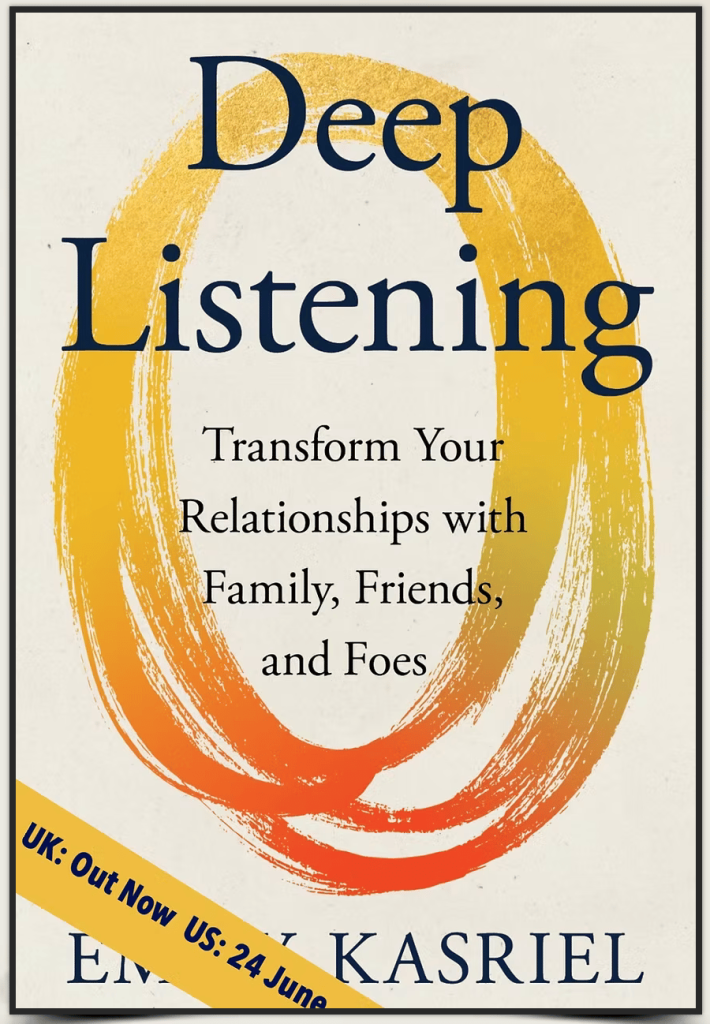
In it, she makes a bold claim: Active listening is not enough.
The business world has distorted Active Listening to paraphrasing the speaker’s message, nodding and smiling.
It’s become a set of techniques “more connected with coercion and manipulation than with meaning-making and understanding.” (quoting Jo A. Tyler)
Deep Listening goes further.
It’s about:
- Hearing what’s said — and what’s not said
- Noticing your own internal chatter as you listen
- Creating space for the speaker to make sense of their thoughts—out loud
Kasriel outlines 8 traps that block our ability to listen including:
🚫 Wanting to control
🚫 Rushing to fix and solve
🚫 Assuming listening = agreeing
And the one that snags me the most?
🚫 Giving advice too soon. 🤦♀️
When we do that, Kasriel says, we rob our speaker of the chance to connect the dots themselves.
But with Deep Listening, our speaker feels safe to share their true ideas and unleash new thinking.
Here’s the line that really struck me:
“Sense-making is your gift to the speaker.”
3 Big Takeaways for Leading Online Sessions 🎧
These insights from Deep Listening have changed how I show up in virtual rooms:
1️⃣ Start by listening to yourself.
You can’t listen deeply to others if you haven’t tuned into your own inner noise—biases, baggage, strong emotions.
👉This is why personal work is professional work for facilitators. It clears the channel for deeper conversations.
2️⃣ Pay special attention to tone of voice.
It tells you more about how the speaker is feeling than facial expressions or gestures.
👉 In virtual sessions, where facial cues can be fuzzy or missed entirely, tone of voice becomes your clearest window into how someone’s really feeling.
3️⃣ Deep Listening transforms both speaker and listener.
This surprised me. I realized that I always thought the main benefit was for the speaker.
But Kasriel explains that when both people play a part in making sense of the narrative, it can elevate understanding and create a profound bond.
👉 And if you’ve ever felt a “breakthrough moment” in a session—you know what I mean.
Try this in your next session 👇
Before you respond to someone, pause and ask:
“Tell me more.”
As Kasriel explains in the Reflecting Back step, this keeps your speaker in charge—and helps them get to a deeper version of their story.
You’ll be amazed at what happens when you stay just a little longer in the listening.
Over to you:
What’s one thing you could do to listen more deeply this week?
Hit reply—I’d love to hear it.
This Week’s Facilitator Finds 💪
In this section, you’ll find curated events, resources, tips, and tools that I’ve found super valuable — and I think you will too!
🔊 How to Tame Your Advice Monster.
If you’re quick to jump in with advice (🙋♀️ guilty), this short, funny, and insightful TEDx Talk by coach Michael Bungay Stanier is a must-watch. It’ll help you press pause on fixing—and lean into listening.
❓ What’s a Question You’ve Been Asking the Wrong Way?
In this LinkedIn post, author Dan Pink shares a simple shift in wording that makes it way more likely people will open up. Gold for facilitators who want richer responses.
🧘♀️ 4-7-8 Breathing Technique
Mentioned in Deep Listening, this calming breathing practice from Dr. Andrew Weil helps you find stillness—so you can show up more grounded and present in your sessions.
💌 Thanks for reading The Quest
I always love hearing your feedback and suggestions. Just hit reply to share your thoughts and ideas.
If you were forwarded this email, you can subscribe to The Quest 👉here.
If you enjoy The Quest, I’d appreciate it if you shared it with anyone you think might like it.
Creatively yours,

Whenever you are ready there are 2 more ways I can help you:
👉Custom coaching & team training. Book a free 15-minute zero-commitment call with me to see how I can support you and your team.
👉 Live Session Design Video Course. Live Session Magic gives you a proven system for designing consistently high-quality online sessions. Join the interest list here and be the first to get access.
👉5-week Live Online Course. The Breakthrough Facilitation course gives you tools, personalized feedback, and a proven framework for designing and leading high-engagement live sessions. Join the interest list and be the first to get the next cohort dates and discounts.