

Most people are using AI to create content faster.
But what if we used it to make our live sessions better?
That’s been the question behind this month’s ✨April AI Mini-Quest✨—a 4-week deep dive into how facilitators, trainers, and course creators can use AI to increase impact, not just speed things up.
Over the past few weeks, we’ve explored:
👉 How facilitators, coaches, and consultants are using AI
👉 Smart ways to use AI in live sessions (with Alexandre Eisenchteter)
👉 Real-world experiments from facilitator + AI tinkerer Spud Marshall
And this week?
I’m turning the lens on myself. 😅
Because at some point, you’ve got to stop learning… and start testing.
No more putting it off…
I’ve got a series of trainings coming up in May, which felt like the perfect opportunity to put all of this into practice.
But I caught myself hesitating.
“I should probably figure this AI thing out properly first…”
After speaking with Alex and Spud I realized that’s the AI trap.
AI is moving way too fast to “master” before you start using it, and waiting until you feel ready usually means you never start.
So instead, I set myself a different challenge.
Run small experiments. Try a few things. See what works—and just as importantly, see what doesn’t.
You learn it by using it in real sessions, with real people, where things are a little messy and slightly unpredictable.
👆At least that’s what my rational brain is telling me.
But the recovering perfectionist in me isn’t so convinced.
I like having a plan. I like knowing things will work.
This… is not that 😅
But I also know that’s exactly where the real insight comes from.
So instead of overthinking it (again)… I started testing.
Here are 3 tiny experiments I’m trying out👇
1️⃣ Designing for smarter data (before the session even starts)
After talking to Spud, I realized something big.
I already collect a lot of data in my sessions—but I don’t always make the most of it.
Between the client brief and tools like my Online Engagement Scorecard, there’s a huge amount of insight already sitting there.
So I’m starting to use AI to actually analyze that data before my sessions.
I’ll look for patterns in challenges, strengths, and gaps, and then use those insights to tailor the content and exercises to what this specific group really needs.
So instead of guessing what might land, I walk into the session with a much clearer sense of where to focus.
2️⃣ Using AI as a sparring partner for activity design
I’m a big believer in learning-by-doing, and I’ve been wanting to design more “simulator-style” activities for a while now.
(Thanks to Michaele Robertson for the nudge on that one.)
So I finally sat down and created a new exercise called:
👉 The “Breaking the Wall of Silence” Simulator
It’s designed to help participants practice techniques for boosting participation in real time and get immediate feedback from their peers.
I used AI as a thinking partner throughout the process.
I started with a rough idea, then went back and forth refining prompts, tightening the structure, and simplifying the instructions.
👆And that last part was key.
Because what I ended up with was much simpler—and much clearer—than my original version.
This really reinforced something Alex shared.
AI isn’t great at creating a full 60-minute workshop.
But when you use it to refine specific pieces of your design, it becomes incredibly useful.
3️⃣ Extending the value beyond the live session
One thing I learned early on as a trainer is to underpromise and overdeliver.
So inspired by my conversation with Spud, I’ve been thinking about how to extend the value of my sessions beyond the live experience itself.
Here’s what I’m testing.
During the session, I’ll intentionally design prompts to capture key insights in the chat—things like challenges, patterns, and opportunities.
Then after the session, I’ll use Notebook LM to synthesize that data into a simple, practical learning tools like audio podcast and “Insight Report” for the participants and my client.
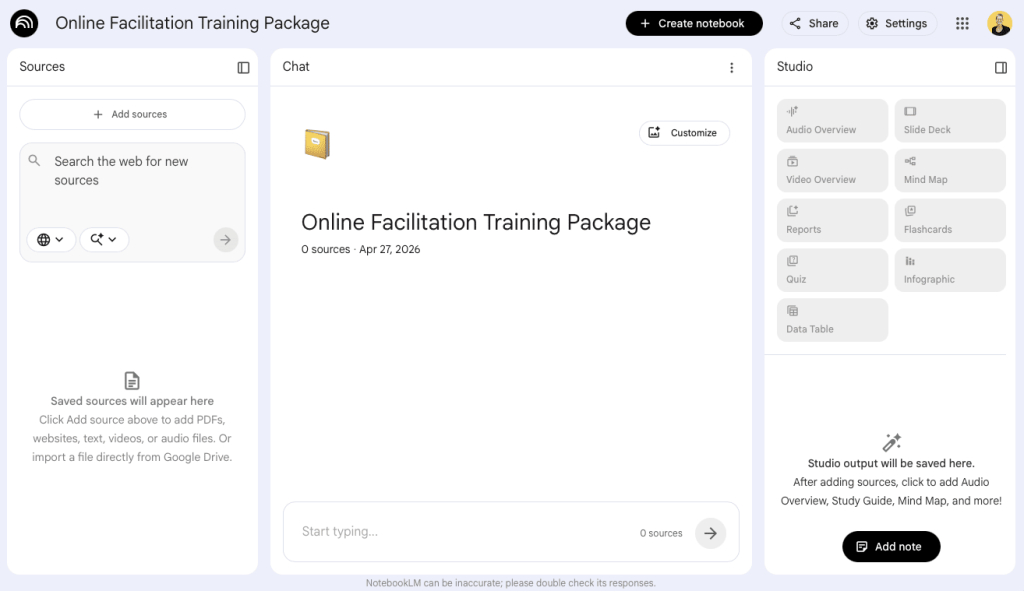
That report will pull data from the session and highlight:
✔ Strengths
✔ Challenges
✔ Recommendations for ongoing support
✔ Curated tools and resources
Instead of the session being a one-off event, it becomes something they can build on and refer back to.
🤔 So… where does this leave us in our AI April Mini-Quest?
I’m still figuring this out.
Some of these experiments will work really well. Others will need tweaking. And a few might flop entirely.
And I very much feel like I’m in the early stages of testing what’s actually possible here.
But already, one thing feels a lot clearer.
👉 The live session leaders who are willing to experiment will get the most out of AI.
Not because they are using more tools.
But because they’re willing to try, adapt, and learn in real time.
I hope this Mini-Quest has sparked a few ideas—and maybe even nudged you to try something new in your own sessions.
This Quest continues… messy experiments and all.
🎤 Over to You
What’s one small way you could experiment with AI in your next session?
Hit reply and let me know—I’d love to hear what you’re trying 👇
🔍 Facilitator Finds (AI edition)
Here are a few resources I’ve found helpful as I’ve been exploring this space:
🎥 Why Google NotebookLM Has Teachers So Excited – A conversation between Higher Ed professionals from Tatiana Rodriguez and Mark Dust about how they are experimenting with NotebookLM, how it stacks up to ChatGPT and some pitfalls to avoid.
🎥 10 Ways to Use NotebookLM in Teaching (YouTube) – a 10 min YouTube video that covers use cases on how to create education resources including audio podcast, video summaries flash cards and more.
🛠️ WiseRoomsAI.com – A LinkedIn post where Spud Marshall breaks down his new AI tool designed to capture the wisdom in the room.
💡 Generative AI and L&D –Work Futurist Terri Horton’s LinkedIn Learning Course that gives you an overview of how AI will impact the L&D field.
💌 Thanks for reading The Quest
I always love hearing your feedback and suggestions. Just hit reply to share your thoughts and ideas.
If you were forwarded this email, you can subscribe to The Quest 👉here.
If you enjoy The Quest, I’d appreciate it if you shared it with anyone you think might like it.
Creatively yours,

Whenever you are ready there are 2 more ways I can help you:
👉Custom coaching & team training. Book a free 15-minute zero-commitment call with me to see how I can support you and your team.
👉 Live Session Design Video Course. Live Session Magic gives you a proven system for designing consistently high-quality online sessions. Join the interest list here and be the first to get access.
👉5-week Live Online Course. The Breakthrough Facilitation course gives you tools, personalized feedback, and a proven framework for designing and leading high-engagement live sessions. Join the interest list and be the first to get the next cohort dates and discounts.
